If you’re new to the world of cryptocurrency, you’ve probably heard the term “private key” thrown around a lot. You may have even come across the famous saying: “Not your keys, not your coins.” But what exactly is a private key? Why is it so important? And how does it connect to cold wallets? In this beginner-friendly guide, I’ll answer all these questions from the ground up — using simple language without drowning you in technical jargon. By the end, you’ll understand why you need to control your own private keys and how cold wallets play a crucial role in keeping your crypto safe.
What Is a Private Key? Let’s Start with a Simple Analogy
A private key is a secret code that proves you own your cryptocurrency assets. It’s known only to you. Without this key, you cannot access, spend, or transfer your funds on the blockchain. Here’s an important concept to understand: your crypto isn’t actually “inside” your wallet. Your coins always live on the blockchain — a massive public digital ledger. Your private key is what allows you to say “these assets are mine” and sign transactions.
Think of it like a safe deposit box at a bank. Anyone can see the box exists (that’s like your public address on the blockchain). But to open the box and take out what’s inside, you need a special key. That’s your private key. As long as you hold that key, you can access your box anytime. Lose the key or give it to someone else, and you lose control over everything inside.
Technically speaking, a private key is usually a randomly generated 64-character hexadecimal string (using numbers 0-9 and letters A-F). But since that’s nearly impossible to memorize, most wallets convert it into a “seed phrase” — a list of 12 or 24 ordinary words that are much easier to write down and store. Those words are essentially your private key in human-readable form.
Public Keys and Addresses: The Twin Relationship
To fully understand private keys, you also need to know about their sibling: the public key. Your public key is mathematically derived from your private key using one-way encryption. And your wallet address (something like “1A1zP1…” for Bitcoin) is derived from your public key. Your address is what you share with others so they can send you crypto.
Here’s a mailbox analogy: Your address (public key) is like a mailbox where anyone can drop letters (crypto) for you. But to open that mailbox, take out the letters, or send them somewhere else — you need the mailbox’s private key. Without it, you can’t touch anything inside.
Quick summary:
• Private Key: Only you should know this. Never share it. This key controls your assets.
• Public Key: Derived from your private key. Safe to share with others.
• Address: Derived from your public key. Used to receive funds.
Why Is the Private Key So Important? (Or: “Not Your Keys, Not Your Coins”)
A core philosophy of cryptocurrency is removing trust from third parties and putting it directly in the hands of users. In traditional banking, your money sits in the bank’s vault, and the bank verifies your identity to let you withdraw. Crypto has no middleman. The only thing that exists is the blockchain’s code — and your private key.
The importance of your private key comes down to three main reasons:
- Proof of Ownership: Your private key is the only evidence that you truly own a specific asset on the blockchain. You can’t go to court and say “those Bitcoins are mine” — because there’s no ID, passport, or fingerprint system. On the blockchain, it doesn’t matter who you are. What matters is which private key you control.
- Transaction Signing Authority: Making a crypto transfer means creating a digital signature. That signature is generated using your private key. Without it, your transaction is invalid. Similarly, without someone else’s private key, they can’t spend your funds.
- Recovery and Access: Your private key (or its human-readable seed phrase) is your ultimate backup. If you lose your phone, break your computer, or forget your password, those words can restore your entire wallet on any compatible device.
Now the saying “not your keys, not your coins” should be much clearer. If you keep your crypto on an exchange (Binance, Bybit, Coinbase, etc.), the private keys belong to the exchange — not you. If that exchange goes bankrupt, freezes withdrawals, or gets hacked, you may never access your funds again because you don’t control the private keys.
What Is a Cold Wallet and How Does It Relate to Your Private Key?
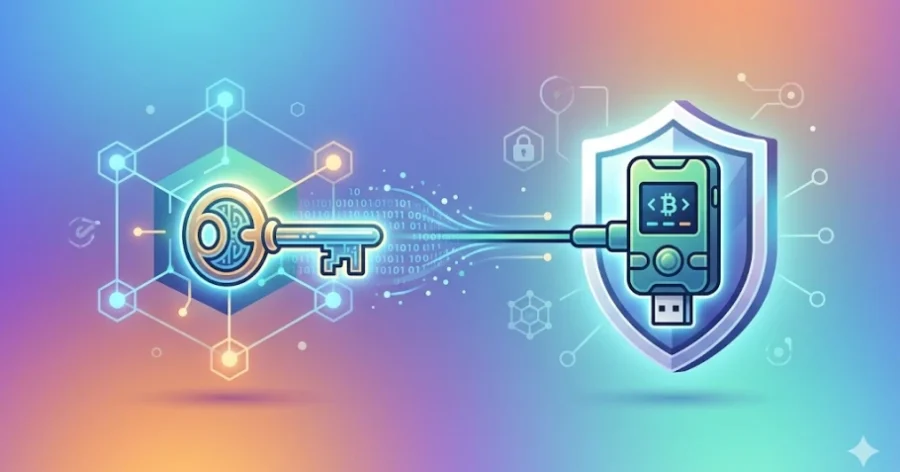
A cold wallet is a device or method that stores your private key completely offline. Hardware wallets like Ledger and Trezor, as well as paper wallets, fall into this category. The entire purpose of a cold wallet is to keep your private key away from any device connected to the internet (computer, phone, cloud).
Here’s the simplest way I can put it: A cold wallet is a physical safe for your private key. Your private key sits safely inside that safe and never comes out. When you want to make a transaction, the cold wallet signs the transaction internally using the private key — and then sends only the signed transaction to your computer. Throughout this process, your private key is never exposed to the internet or your computer.
This is why cold wallets are the most effective way to protect your private key. Hot wallets (like MetaMask or Trust Wallet) or exchange accounts keep your private key in an internet-connected environment. That opens the door for hackers, keyloggers, or phishing attacks to steal it. A cold wallet completely eliminates that risk.
Key Differences Between a Private Key and a Cold Wallet
Let’s clarify the distinction with a simple comparison:
| Feature | Private Key | Cold Wallet |
|---|---|---|
| Definition | The secret code that gives ownership and spending authority over assets | A device or method that stores the private key offline |
| Physical object? | No — it’s a mathematical value (a number or word list) | Yes — a physical device or piece of paper |
| Where is it stored? | Inside a wallet (depending on user preference) | Offline — in a safe, drawer, or dedicated hardware device |
| Internet connection? | Depends on the environment — online for hot wallets, offline for cold wallets | Completely offline |
| If lost or destroyed | Assets become permanently inaccessible | Can be restored to a new device using the seed phrase |
| Examples | 64-character hex code or 12/24-word seed phrase | Ledger Nano X, Trezor Safe 3, paper wallet |
In other words: a cold wallet is not the private key itself — it’s the container that holds and protects your private key. Your private key is your digital identity. A cold wallet is the tool that keeps that identity secure.
How Does a Cold Wallet Protect Your Private Key?
Here’s a step-by-step scenario to visualize how cold wallets keep your private key safe:
- You buy a Ledger device. During setup, the device generates a 24-word seed phrase (your private key in human-readable form). You write those words on paper and lock them in a safe. The device’s secure chip stores the private key internally.
- You open Ledger Live or MetaMask on your computer and start a transaction — for example, sending 0.1 ETH. Your computer prepares the unsigned transaction and sends it to your Ledger device.
- Your Ledger’s screen shows the transaction details: “Send 0.1 ETH to address 0x123…” You physically press buttons on the device to confirm.
- The device uses its internal private key to sign the transaction — creating a digital signature entirely inside the secure element, without ever exposing the private key to your computer or the internet.
- The signed transaction is sent back to your computer, which broadcasts it to the blockchain.
The most critical point here is: Your private key NEVER touches your computer or the internet. Even if your computer is infected with advanced malware, keyloggers, or trojans, your private key remains safe — because it’s physically locked inside a device that requires you to push buttons to approve anything.
Paper wallets work on a more basic level: the private key is written on a piece of paper and stored under lock and key. To use it, you manually type the key into a software wallet (which carries some risk) or scan a QR code. Paper wallets are secure as long as they stay offline, but they’re much less convenient to use daily.
What NOT to Do When Using Private Keys and Cold Wallets
Whether you use a cold wallet or a hot wallet, your private key’s security depends entirely on your own behavior. Here’s what you should never do:
- Store your seed phrase (private key word list) digitally: No photos, no computer notes, no cloud uploads, no sending it in messages. The moment you do this, your private key becomes online and becomes a target for hackers.
- Share your seed phrase with anyone: Not “Ledger support” calling you, not a friend, not anyone. Real support teams will never ask for your seed phrase. Anyone who asks is 100% a scammer.
- Import an old MetaMask seed into a new cold wallet: The entire security of a cold wallet is based on the fact that its seed was generated fresh, offline. If you import a seed that was previously used on an internet-connected device, that seed is already “dirty” — you’ve defeated the purpose of buying a cold wallet.
- Use a cold wallet on a computer you don’t trust: While the cold wallet protects your private key, you are still responsible for checking transaction details (receiver address, amount) on the device’s screen. A virus on your computer could try to show you a fake address.
- Rely on only one backup: If you have only one copy of your private key and it’s destroyed in a fire, flood, or theft, your assets are gone forever. Keep at least 2 copies in separate physical locations (home safe, bank safe deposit box, trusted relative).
External resource (DoFollow): For official documentation on hardware wallet security, visit Ledger — one of the most trusted cold wallet manufacturers.
Internal link: Read our complete guide on Why Are People Paying Fortunes for JPEG NFTs? to understand digital asset value.
Sıkça Sorulan Sorular
No. A cold wallet is just a tool to access your private key. The cold device itself is not the private key. As long as you have your seed phrase (word list) backed up, you can buy a new cold wallet, enter your seed phrase, and regain full access to all your assets — even if the original device is lost or destroyed.
Technically yes. For example, you could write your private key on paper and lock it in a bank safe (that’s essentially a paper wallet). But every time you want to make a transaction, you’d have to manually type that key into a software wallet — which is both inconvenient and risky. Hardware wallets offer the best combination of security and ease of use.
If you use a hot wallet (like MetaMask) on your computer or phone and your device gets infected with malware or a keylogger, your private key could be stolen. Phishing sites might also trick you into entering your private key on a fake wallet interface. For large amounts of crypto, a cold wallet is strongly recommended.
No, not at all. A wallet password (like the one you set for MetaMask) is only used to lock the wallet software. Your private key (or seed phrase) is the actual proof of ownership on the blockchain. If you forget your wallet password, you can reset the software and restore your wallet using your private key. But if you lose your private key, no password or support team can help you recover your assets.
Yes, to a large extent. Devices like Ledger use a Secure Element chip, which makes it nearly impossible for an attacker to physically extract the private key. They also have PIN limits (usually 3 wrong attempts wipes the device). So even if someone steals your cold wallet, they cannot access your private key without knowing your PIN.